Rain and growing pastures bring relief to dairy farmers facing a cost squeeze.
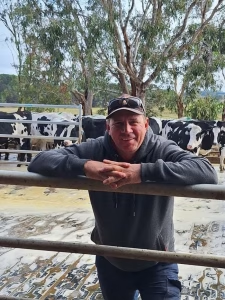
Dairy farmer Sam Kermond on his family's dairy property at Nullawarre. Picture: Nicole Cleary
After a bruising twelve months that left dams dry, pastures bare and wallets stretched, dairy farmers across southern Australia are daring to feel something they have not felt in a while – cautiously optimistic.
From the rolling hills of South Gippsland to southwest Victoria and the paddocks of south-east South Australia, grass is growing, rain has fallen and the mood has lifted.
But a stubborn hangover of high input costs is making sure nobody gets too comfortable.
Across most key dairying regions, the autumn break has delivered where last year it largely failed.
Pastures are responding, fodder reserves are in reasonable shape and producers are breathing easier heading into winter.
The common thread of concern, however, is unavoidable – urea has roughly doubled in price, diesel and grain costs remain elevated, and while a milk price rise is anticipated, few expect it to fully absorb what has been a significant surge in the cost of doing business.
For Perrin Hicks, of Hicks-Jacobs Dairies at Mount Compass in South Australia the contrast with last season could not be more pronounced.
Last year, the first meaningful rain did not arrive until the end of May.
This year, an early April break followed by consistent rainfall – 76mm in May – has the operation firing.
“I said to a neighbouring farmer yesterday – I’m too scared to say it but it’s been a really good start for us,” Perrin said.
Pasture growth rates have reached 40kg of dry matter per hectare per day across their farms. A lack of frosts through the same period has been a key contributor.
Fodder stocks are in solid shape but Perrin said they do need more run-off rain to top up aquifers.
On milk price, he estimates input costs have risen by around 60 cents per kilogram of milk solids and while he expects a price adjustment, he is not counting on it covering the full gap.
Nullawarre dairy farmer Sam Kermond said the recovery in southwest Victoria had been significant.
On his family property, perennial rye-grass is sitting at 3600kg of dry matter per hectare, with a post-grazing residual of 1600kg per hectare – conditions Sam said are ideal.
At the start of 2025, cows were receiving 11-13kg of grain and silage per head per day just to maintain production.
That figure has eased to 5-7kg.
Sam said they are managing input cost pressures through tighter fertiliser application rates and more efficient machinery use.
The mood across the region has shifted measurably.
“Everyone has seed in the ground – if it hasn’t taken off, it’s about to,” Sam said.
“Everyone is in a lot better state of mind.”
South Gippsland farmers have also had plenty of grass growth.
Leongatha dairy farmer Benjamin Vagg said follow-up rain that failed to materialise last year arrived in time this season.
Like many other farmers, he made a deliberate move to offset rising urea costs by pushing as much effluent pond nutrients out across the farm as possible.
His pasture cover is sitting at 2800kg of dry matter per hectare, a figure he expects to climb to between 3000kg and 3200kg within six to eight weeks as he dries off his herd for the season.
At the same point last year, he had a green pick and little else.
Dams are yet to fill, and Benjamin shares the broader regional nervousness about run-off rain heading into spring.
On milk price, he said the industry needs processors to move with intent.
“$9 is where we need them to start but $9.50 would be fantastic,” he said.