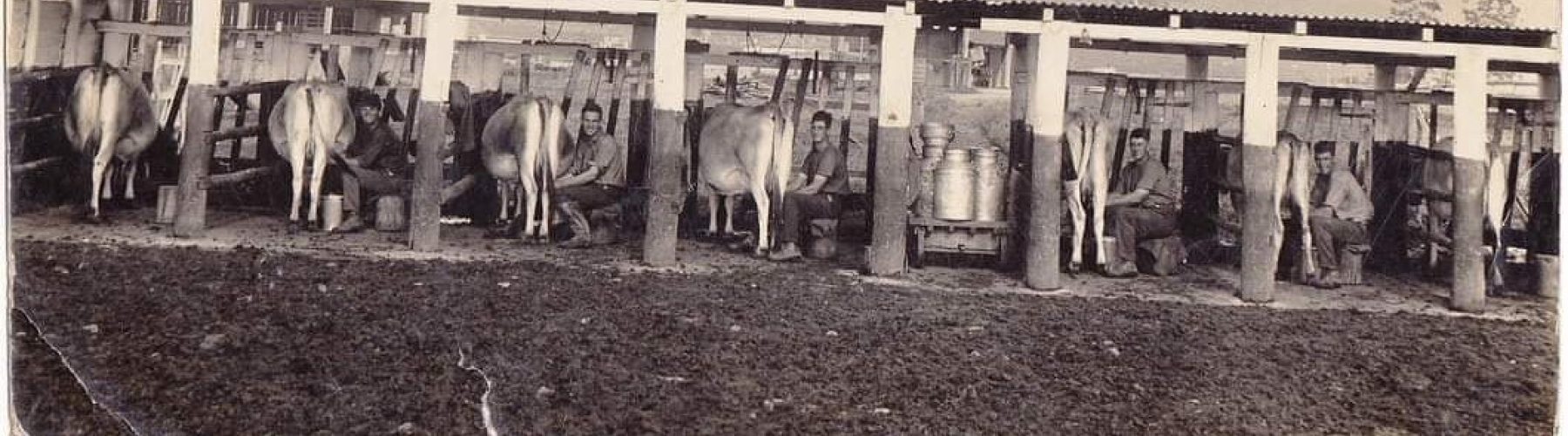
SADA Establishment to 1966
Foundation, wartime service and the making of a permanent dairy voice
Why SADA emerged
The story of the South Australian Dairyfarmers' Association begins with pressure: pressure on price, pressure on standards, pressure from urban growth, and pressure on farming families who were carrying a perishable product into a market that did not always value the work behind it. By the mid-1930s South Australian dairy farmers had learned that goodwill and local reputation were not enough. Milk had to be collected, cooled, carried and sold every day. Butterfat, herd health, inspection, zoning, cartage, retailer margins and government regulation all touched the farmer before the farmer could be paid. SADA emerged because those practical problems needed a practical, united voice.
The Association was not created in a vacuum. It drew from earlier dairymen's groups, local producer committees, metropolitan milk supply debates and the long memory of farmers who had argued for fair treatment through the 1920s and early 1930s. The establishment moment in 1936 therefore represented more than a new name. It marked the decision to speak as an industry, to gather evidence, to influence legislation, to defend standards, and to insist that the farmer's position be heard wherever milk and dairy policy were being decided.
The foundation generation
The first decades were shaped by a generation of leaders who combined farmer credibility with organisational discipline. Herbert R. Walsh, G. L. Hampton, A. Brabham and Ivan R. Elliott sit at the front of the presidential story. Alongside them, John Reid Hewland and then Col. Alexander Harold Nelson provided the early secretarial and administrative spine. Their work gave SADA the habit that would define it for the next ninety years: collecting the facts of farm life and turning them into persuasive advocacy.
The early SADA did not have the modern resources of a large peak body. It relied on meetings, correspondence, district networks, newspaper visibility and relationships with government. Yet those methods mattered. They allowed producers from different regions and production systems to see their interests as connected. A metropolitan milk supplier, a hills dairyman, a Murray producer or a South East farmer might face different seasonal and market pressures, but they shared the same need for orderly marketing, fair price recognition and credible representation.
Milk, order and regulation
Much of SADA's early history revolves around the tension between free trade in milk and the need for order in a product that could not be stored on farm. Milk is unlike grain or wool. It is produced every day and it demands immediate handling. The earliest SADA campaigns therefore focused on matters that might appear administrative but were in fact central to farm survival: milk boards, supply zones, inspection, price setting, quality standards, vendors, factory relationships and the division of returns across the chain.
SADA's role was not simply to resist regulation. Often it sought better regulation: systems that recognised the cost of production, rewarded quality, protected public health and prevented destructive undercutting. The Association's strength came from understanding that dairying needed public confidence. Farmers could only win the argument for fair returns if they also accepted the obligation to supply a safe and reliable food. This balance - farmer interest and public interest - became a recurring feature of SADA's advocacy.
War, labour and supply security
The Second World War placed dairy into a national supply context. Labour shortages, transport constraints, rationing, feed availability and controlled markets tested producers and the organisation that spoke for them. SADA had to argue for farmers at a time when governments were directing resources to the war effort and when consumers expected essential food to be available. The Association's work in this period reinforced an enduring claim: dairy is not optional infrastructure. It is part of the daily food system.
The war and immediate post-war period also revealed the resilience of family dairying. Farms absorbed labour disruption, rising costs and weather risk while maintaining supply. SADA's leaders had to frame these pressures in terms that government could act upon: fair prices, access to materials, recognition of labour needs, and an understanding that milk production could not be switched on and off without consequence. The experience deepened the Association's capacity to speak as an essential industry rather than simply as a commodity group.
The Nelson administrative era
Col. Alexander Harold Nelson's long period as General Secretary, from the late 1930s through the 1950s, gave the Association continuity at precisely the time it needed it. Nelson's military title and organisational manner fitted the requirements of a young body seeking authority. He helped make SADA more than a meeting of concerned farmers. He helped give it records, correspondence, process, external standing and a professional voice.
This period matters because institutions are built through routine as much as through moments of crisis. Annual meetings, reports, notices, submissions, visits and the disciplined presentation of arguments created an organisational memory. The leaders changed, seasons changed and governments changed, but SADA retained a thread of advocacy. Nelson's contribution was to hold that thread together through the formative decades.
Ivan Elliott and the long presidency
Ivan Ross Elliott's presidency, extending from the late 1930s until his death in 1963, stands as one of the central chapters in SADA history. His tenure covered war, post-war reconstruction, changes in milk regulation, shifts in farm technology, and the increasing complexity of dairy markets. Elliott's leadership represented continuity, but not passivity. He presided over an Association that had to keep adapting while protecting the core principle that dairy farmers required a strong collective voice.
Elliott's importance lies partly in duration and partly in tone. He gave the Association a farmer's authority over a generation of industry change. He also embodied the idea that SADA's leadership needed to be rooted in the credibility of producers themselves. Under Elliott, SADA remained close to the practical concerns of members: prices, costs, seasonal conditions, supply arrangements, government policy, and the dignity of dairy farming as a profession.
Industry change after the war
The 1950s brought more than recovery. They brought changing expectations about productivity, quality and farm management. Refrigeration, transport, factory consolidation, improved herd practices and more sophisticated payment systems all altered the way dairy farms interacted with processors and consumers. SADA had to keep pace with that change. The Association's work increasingly sat at the intersection of farm economics, science, public health and market organisation.
These years also reinforced regional complexity. South Australian dairying was never a single landscape. The metropolitan fringe, the Adelaide Hills, the Lower Murray, the Fleurieu and the South East all had distinctive production histories. SADA's challenge was to hold these differences within a united position. That capacity to represent diversity without losing focus would become especially important in later equalisation and restructuring debates.
Transition after Elliott
The passing of Ivan Elliott in 1963 marked an emotional and institutional transition. Harold Loechel then carried the presidency through a period that asked SADA to honour its founding generation while preparing for a more modern, more technical and more politically complex dairy industry. David J. Higbed, who became General Secretary in 1959, was central to that modernisation. With Higbed in the executive role and Loechel in the presidency, SADA moved from the age of foundation and consolidation toward the debates that would define the late 1960s and 1970s.
By 1966 the Association had become an established voice in South Australian agriculture. It had survived its difficult birth, the pressures of war, the administrative demands of regulation, and the long challenge of keeping regional producers aligned. It had developed a culture of leadership that valued service, persistence and practical evidence. Most importantly, it had proved the founding proposition: dairy farmers were stronger when they acted together.
In summary
The period from establishment to 1966 is therefore the story of SADA becoming necessary and then becoming permanent. It began because farmers needed a fairer say in a regulated, perishable and politically sensitive market. It endured because leaders such as Walsh, Hampton, Brabham, Elliott, Loechel, Hewland, Nelson and Higbed converted that need into an organisation. The legacy of those first thirty years is not only in the policies pursued, but in the habit of unity they created. That habit became SADA's inheritance, and it remains the reason the Association could face every later decade of industry change.
The farmer voice becomes a public institution
A useful way to present this early period is to contrast the fragility of the farm business with the public importance of the product. Dairy farmers were managing animals, feed, water, labour and weather, yet the product they supplied was treated by the community as a daily certainty. That gap between private risk and public expectation is at the heart of SADA's establishment story. The Association gave farmers a mechanism to say that reliable milk supply could not be separated from fair treatment of the people producing it.
The early leaders also understood that unity had to be earned. It was not enough to announce a statewide association and expect loyalty to follow. SADA had to prove that it could represent metropolitan and regional interests, that it could deal seriously with government, and that it could explain complex regulation in practical language. This work was patient and repetitive, but it built trust. When later debates arose, members could look to an organisation that had already shown it could endure.
Another feature of the period is the close relationship between advocacy and record-keeping. Annual reports, minutes, correspondence and public statements were not just administrative products. They were the evidence base from which the Association built authority. SADA's capacity to speak persuasively depended on knowing what farmers were experiencing and being able to present those experiences in a disciplined way. That pattern remains recognisable in modern SADA work.
The human dimension of the foundation era
The people in this period should not be presented only as names on a timeline. They were men carrying responsibility at moments when the future of organised dairy representation was uncertain. Walsh and the early presidents helped create the platform. Elliott gave the presidency continuity and farmer authority. Hewland and Nelson helped convert aspiration into administration. Loechel and Higbed then bridged the Association into the next phase. Together they show that SADA was built by both visible leaders and those who did the detailed organisational work.
This human dimension is important for a 90-year presentation because it explains why the Association survived. SADA's history is not simply a sequence of policy positions. It is a story of service. Leaders gave time to meetings, travel, correspondence and disputes because they believed the industry needed a collective future. The establishment-to-1966 period should therefore be presented as the creation of a culture: a culture in which dairy farmers accepted that representation was a shared responsibility.
By 1966, SADA had accumulated three decades of credibility. It had shown that it could argue firmly without losing sight of the public interest. It had helped the industry deal with regulation without becoming merely an arm of government. It had maintained unity through war, change and leadership transition. Most importantly, it had given South Australian dairy farmers a durable institution, capable of being inherited by the next generation.
SADA 1966 to 1996
Modernisation, equalisation and the bridge to a deregulated world
Modernisation and pressure
The thirty years from 1966 to 1996 were years of modernisation, restructuring and, at times, deep uncertainty for South Australian dairy farmers. SADA entered this period with the standing built by its founding generation, but the questions before it were changing. The issues were no longer only about the orderly supply of metropolitan milk or the basic architecture of regulation. They were increasingly about regional competition, factory change, national policy, milk equalisation, farm scale, processor power, and the capacity of family farms to survive in a more exposed market.
This was also the period in which the Association's leadership passed from Harold Loechel to Norman Mervyn Green, Aub Kretschmer, Allan Manning, Ray Heinrich and then Frank Beauchamp. In the office, David J. Higbed remained the central executive figure until the late 1980s, followed by Terry Inglis, Adrian Scott and then Inglis again during the early 1990s. The continuity of executive experience helped SADA navigate a policy environment that was increasingly technical, national and contested.
The Loechel to Green transition
Harold Loechel's presidency after Elliott provided a bridge between the long foundation era and the new pressures of the late 1960s. His period is remembered as one of service and transition: the Association retained its core identity while preparing for a different style of advocacy. When Norman Mervyn Green assumed the presidency in 1968, SADA gained a leader associated strongly with the Lower River Murray and with the practical concerns of dairy producers outside the metropolitan frame.
Green's tenure, running through to 1981, was long enough to shape the Association's tone for an era. The key task was to keep SADA relevant as dairy policy became more complicated. Pricing, quotas, supply arrangements, processing capacity, herd quality, farm viability and regional representation were all live issues. Green's leadership helped keep the farmer voice visible through debates that could otherwise become dominated by administrators, processors and government agencies.
A changing dairy economy
By the 1970s, the economics of dairying were shifting. Farms were under pressure to improve productivity, adopt new practices and respond to cost increases. The cost-price squeeze was not an abstract phrase; it was lived through feed bills, labour demands, debt, machinery, herd improvement, water, pasture management and the daily discipline of milk production. SADA's reports and newsletters from this broad period repeatedly show an organisation concerned with the same central question: how could dairy farmers remain viable while meeting rising expectations from processors, regulators and consumers?
This question sat beside another: how should the benefits and costs of regulation be shared? Farmers accepted quality standards and supply obligations, but they expected the pricing and marketing system to recognise those obligations. SADA's advocacy continued to press for fairness in the chain, not merely for higher returns in isolation. It argued that a stable dairy industry required a workable relationship between farm production, processing investment, consumer needs and government policy.
The Higbed executive years
David J. Higbed's long service as General Secretary is one of the defining features of this period. Having commenced in 1959, he remained the executive constant through the Green years and into the later 1980s. Higbed's importance lies in the professionalisation of SADA's representation. He operated in a period when dairy policy was increasingly shaped by papers, committees, submissions, inter-state negotiations and formal industry forums. The Association needed not only passion, but also documentation and persistence.
Higbed's work helped connect the boardroom, the farm gate and the policy table. The General Secretary's function was to convert member concerns into arguments capable of influencing decision-makers. In a period of increasing complexity, that function became essential. The endurance of Higbed's service also gave SADA institutional memory as the industry moved toward the major structural questions of the 1980s and 1990s.
Kretschmer and the path toward restructuring
A. G. 'Aub' Kretschmer's presidency from the early 1980s to 1989 sits at a point of intensifying structural debate. By this stage, SADA was dealing with issues that were clearly bigger than South Australia alone. National dairy policy, manufacturing milk, market support, pooling and equalisation were all part of the landscape. South Australian farmers needed representation that could protect local interests while understanding the national framework.
Kretschmer's period therefore required both regional sensitivity and national awareness. The Association had to explain to members why distant policy debates mattered to the cheque received on farm. It also had to insist that South Australia's production systems, processor relationships and regional conditions were not incidental. They were central to whether reform would be fair. The skill of the period was to remain constructive without surrendering the farmer interest.
Equalisation and the Manning years
Allan Manning's presidency from 1989 to 1993 coincided with one of the most consequential policy chapters in modern SADA history: the movement toward statewide equalisation. Equalisation was not merely a technical adjustment. It went to questions of fairness, regional balance, supply security and the relationship between different classes of milk. The debates required SADA to manage strongly held views and to help the industry move through a complicated transition.
The newsletters and reports from the era present equalisation as a process involving meetings, explanations, negotiation and the building of confidence. SADA's role was to keep farmers informed and to argue for arrangements that recognised the realities of production. Manning's tenure therefore deserves recognition as a period of difficult but necessary structural work. It helped move the Association from the older regulatory model toward the world that would follow deregulation and market liberalisation.
Executive transition and early 1990s complexity
The late 1980s and early 1990s also brought executive transition. Terry Inglis followed Higbed, Adrian Scott served during the early 1990s, and Inglis returned before the mid-1990s change to Chris Luz-Raymond. These changes occurred at a time when continuity was difficult but essential. SADA was dealing with equalisation, national debates, processor relationships, member confidence and the beginning of a more public communications environment.
This period shows the Association's dependence on both elected and employed leadership. Presidents brought farmer authority and board direction. Secretaries and chief executives brought administrative capacity, policy drafting and organisational continuity. When the two worked together, SADA could engage simultaneously with members, government, processors and national industry bodies.
Heinrich, Beauchamp and the threshold of a new era
Ray Heinrich's presidency from 1994 to 1996 carried SADA through the immediate aftermath of the equalisation debates and into the threshold of a more market-driven era. His period was short compared with Green or Elliott, but important because it sat at a hinge point. The industry was preparing for the circumstances that would shape the next generation: deregulation, sharper processor competition, changing farmer expectations and the need for a more modern communications style.
Frank Beauchamp's association with the presidency in 1996 marked another moment of transition. By then the Association was looking toward new executive leadership and a changed strategic environment. The arrival of Chris Luz-Raymond as chief executive in 1995-96 would help SADA reposition itself for the late 1990s and early 2000s.
In Summary
The period from 1966 to 1996 is best understood as the bridge between the regulated dairy world built by the founders and the competitive world that followed. SADA's task was to preserve unity while guiding farmers through modernisation, cost pressure, regional tension and structural reform. The Association did not avoid difficult debates. It entered them, translated them, and tried to secure outcomes that farmers could live with. That is why the leadership of Loechel, Green, Kretschmer, Manning, Heinrich and Beauchamp, supported by Higbed, Inglis, Scott and Luz-Raymond, deserves recognition as the generation that carried SADA across the most complex policy bridge in its history.
Further presentation emphasis: managing disagreement while preserving unity
The period from 1966 to 1996 should be presented as a test of SADA's maturity. The founding period had proved the need for organisation; the next thirty years tested whether that organisation could manage disagreement. Equalisation, pricing systems, regional interests, factory relationships and national reform did not always produce easy consensus. SADA's value was that it created a place where difficult arguments could be held within an industry framework rather than spilling out as division.
That function is often under-appreciated. A peak body is not only successful when it wins a public campaign. It is also successful when it prevents fragmentation, keeps members informed, and gives government a credible point of engagement. Through the Green, Kretschmer and Manning years, SADA had to balance local loyalties with statewide outcomes. The Association's reports and newsletters from this broader era show repeated efforts to explain policy change, maintain confidence and ensure that producers understood what was at stake.
The era also demonstrates the importance of leadership succession. The shift from Loechel to Green, then to Kretschmer, Manning, Heinrich and Beauchamp, occurred alongside executive changes from Higbed to Inglis, Scott and Luz-Raymond. Each transition could have weakened the organisation. Instead, SADA retained continuity because its purpose was clear: dairy farmers needed a body that could carry their interests into increasingly complex policy arenas.
The equalisation legacy
Equalisation deserves particular attention in this presentation because it captures the character of the 1966-1996 period. It was technical, difficult and deeply connected to fairness. It required members to think not only about their individual circumstances, but about the structure of the whole South Australian dairy industry. For SADA, the task was to keep the debate anchored in farmer realities: the cost of production, the risk of supply, the importance of regional confidence and the need for a sustainable system.
The legacy of the equalisation years was not that all tension disappeared. Rather, it was that SADA had helped the industry move through a major structural argument with a shared institutional voice. That experience prepared the Association for the next upheaval: deregulation and the market exposure of the late 1990s and early 2000s. Without the habits developed through equalisation - member explanation, formal meetings, careful negotiation and disciplined advocacy - the post-1996 period would have been harder.
By 1996, SADA was no longer the same organisation that had entered the late 1960s. It was more experienced, more policy-literate and more aware of national forces. Yet it still rested on the same foundation: representation grounded in the farm gate. That combination of continuity and adaptation is the central message of the period.
What this period contributed to SADA
The lasting contribution of the 1966 to 1996 period is that it taught SADA how to operate in complexity. The issues were no longer capable of being reduced to a single price demand or a single regulatory reform. They involved competing regions, changing markets, national policy settings and the emotional reality of farmers being asked to adapt. SADA's achievement was to keep those issues connected to the lived experience of producers.
For presentation purposes, this period should be framed as the Association's second foundation. The first foundation created SADA; the second foundation prepared it for the modern era. By the time SADA reached 1996, it had experience in structural reform, member communication, political negotiation and leadership transition. Those capacities would become essential when deregulation and a more exposed market arrived. The organisation that entered the next period was not untouched by conflict, but it was stronger because it had learned how to lead through it.
SADA 1996 to 2026
Deregulation, renewal and the modern peak-body role
From deregulation to renewal
The period from 1996 to 2026 covers one of the most dramatic transformations in South Australian dairy history. SADA entered this era after the debates over equalisation and structural reform. It would soon confront national deregulation, processor consolidation, changing retail power, a new public communications environment, biosecurity threats, drought, water policy, animal welfare expectations, environmental scrutiny and the challenge of keeping a smaller number of farms politically visible.
This thirty-year period was led by presidents Frank Beauchamp, Phil Kernick, Jeff Wright, David Basham, John Hunt and Robert Brokenshire, with Chris Luz-Raymond, Ken Lyons and Andrew Curtis carrying the chief executive role across successive phases. The thread linking the period is adaptation. SADA had to remain a member organisation while becoming a modern advocacy, communications and policy body capable of dealing with government, media, national industry structures, processors and consumers.
Late 1990s: positioning for a different industry
The late 1990s were a threshold. Chris Luz-Raymond's executive period coincided with the need to modernise the Association's approach as the dairy industry moved closer to deregulation. The old certainties of regulated returns were weakening. Farmers needed representation that could explain change, influence transitional arrangements and maintain confidence at a time when many families were questioning the future.
Frank Beauchamp's short presidential period and the later presidency of Phil Kernick came as SADA was adjusting to that environment. The Association needed to hold members together through uncertainty while also acknowledging that the future would demand sharper commercial awareness, stronger communications and more active engagement beyond the traditional farm-policy circuit.
The Kernick and Wright years
Phil Kernick's presidency from 2000 to 2002 sat close to the national deregulation moment. For South Australian dairy farmers, the early 2000s were not simply a policy change; they were a test of resilience. Deregulation altered expectations about price, risk and market exposure. SADA's role was to speak for farmers who were still producing the same daily essential product, but under a more exposed commercial framework.
Jeff Wright's presidency from 2002 to 2004 continued the work of stabilising the Association's voice after deregulation. The issues of the day were increasingly linked to farm viability, processor relationships, competition, market signals and the need for producers to invest while operating under tighter margins. These years laid the groundwork for the longer Basham presidency that followed.
David Basham and long-form advocacy
David Basham's presidency from 2004 to 2016 is one of the most substantial modern chapters in SADA history. His tenure was marked by persistence across policy, media and industry development. Basham represented the Association through years in which farm numbers continued to decline, but the importance of dairy to regional economies and food supply remained strong. His leadership helped SADA speak with confidence in an environment where agriculture had to compete harder for political attention.
The Basham years also saw SADA increasingly engage with branding, consumer understanding and broader industry positioning. The creation and development of SADA Fresh gave the Association a distinctive public-facing instrument. It connected advocacy to consumer choice and generated a platform through which South Australians could see local dairy as more than a commodity. In a time when farmer organisations were often seen only through policy disputes, SADA Fresh gave SADA a positive and visible public identity.
Ken Lyons and executive continuity
Ken Lyons served as chief executive from 2000 to 2016 and is central to understanding the modernisation of SADA. His period overlaps the Kernick, Wright and Basham presidencies, giving the Association long executive continuity after deregulation. Lyons' work helped SADA move from the older model of industry representation into a more contemporary peak-body role: policy development, media response, government engagement, member communication and project delivery.
Lyons' tenure coincided with a wide range of issues, including farmgate pricing, processor behaviour, drought and seasonal pressure, water, animal welfare, food standards, biosecurity preparedness and national dairy representation. His importance was not confined to any single campaign. It lay in keeping SADA credible, active and visible through a period when the industry could easily have lost influence as farm numbers fell.
John Hunt and the post-2016 period
John Hunt's presidency from 2016 to 2023 brought SADA into another phase of strategic advocacy. The Association was dealing with processor disruption, public scrutiny of milk pricing, changing expectations around sustainability, and continuing concern about the viability of family dairy farms. Hunt's leadership emphasised steadiness and industry development at a time when dairy farmers were being asked to absorb change from many directions at once.
Andrew Curtis' chief executive tenure from 2016 brought a sharper contemporary policy and communications focus. The Association engaged with government on drought, water security, supply chain vulnerabilities, biosecurity, consumer campaigns, labelling, animal welfare and the long-running issue of virtual fencing. The work reflected a modern reality: SADA had to argue not only within dairy, but across government portfolios, media channels and public expectations.
Robert Brokenshire and the 90-year horizon
Robert Brokenshire's presidency from 2023 has come as SADA approaches its 90-year milestone. This has been a period in which the Association has drawn directly on its history: the need for unity, the importance of a farmer voice, and the lesson that dairy's daily supply role must be understood by government and the public. The contemporary agenda includes water security, farm viability, drought response, national advocacy reform, labelling integrity, workforce, biosecurity and the place of SADA Fresh within industry growth.
The recent period has also highlighted food security. Diesel, fertiliser, transport, daily tanker collection and processor capacity are not peripheral concerns. They are the infrastructure of fresh food. SADA's argument has been that dairy must be understood as an essential service because milk cannot be stored on farm and because the chain from cow to consumer operates every day. This is a modern expression of the same logic that led to SADA's formation in the 1930s.
Industry development and strategic renewal
By 2026, SADA's work has become broader than defensive advocacy. It includes industry growth, consumer engagement, sustainability expectations, the South Australian Dairy Industry Action Plan, SADA Fresh, the Do Dairy message, and policy work intended to keep farms viable even as farm numbers decline. The Association is increasingly required to show that dairy can meet environmental, welfare and community expectations while remaining commercially realistic.
This is not a departure from SADA's history; it is a continuation of it. Every generation has had to translate the realities of dairy farming into the language of the day. In the 1930s that language was orderly marketing and fair price. In the 1970s and 1980s it was regulation, equalisation and structural reform. In the 2000s and 2020s it is viability, supply chain resilience, consumer trust, sustainability and strategic growth.
In Summary
The period from 1996 to 2026 is therefore the story of SADA becoming a modern peak body without losing its farmer centre. It navigated deregulation, sustained advocacy after the loss of old market protections, built public-facing initiatives, defended farmer viability and adapted to new expectations around food systems and sustainability. The leadership of Beauchamp, Kernick, Wright, Basham, Hunt and Brokenshire, supported by Luz-Raymond, Lyons and Curtis, shows an organisation prepared to evolve. SADA's achievement in this period is that it remained relevant when the industry around it changed profoundly. As it reaches ninety years, the Association's central purpose is still recognisable: to give South Australian dairy farmers a strong, practical and united voice.
Advocacy after the old protections
The modern period should be presented as the story of advocacy after the old protections. Deregulation and market exposure did not remove the need for representation; they increased it. Farmers still faced daily production risk, but they now had to navigate a more volatile commercial environment. SADA's work therefore shifted from defending a regulated structure to defending the conditions that allow farms to remain viable within a competitive system.
This meant broadening the Association's language. SADA still spoke about price and costs, but it also spoke about food security, supply chain resilience, consumer trust, sustainability, local branding and the role of dairy in regional economies. The Association had to speak to ministers, departments, processors, retailers, media and consumers. It had to respond quickly to public issues while still doing the slow work of policy development. The modern SADA became more outward-facing because the environment required it.
SADA Fresh is a significant symbol of that change. It showed that a farmer organisation could build a positive public connection to local dairy. It did not replace advocacy; it complemented it. By helping consumers identify with South Australian dairy, SADA Fresh reinforced the broader message that the industry is part of the state's identity and not merely a supply contract hidden behind the supermarket shelf.
The 90-year lesson
As SADA approaches 2026, the Association's history becomes an advocacy asset. The same reasons that led to formation in 1936 are still visible in modern form. Milk is still produced every day. Farmers still carry private risk for public benefit. Government decisions still shape water, regulation, transport, animal welfare, biosecurity and land use. Consumers still need confidence in the food system. The difference is that the language of the debate now includes ESG expectations, climate adaptation, technology, workforce, traceability and national advocacy reform.
The current challenge is therefore not to preserve the past as a museum piece, but to use it as proof of purpose. The Association has lasted because each generation renewed the method of representation. Basham and Lyons helped modernise public presence after deregulation. Hunt and Curtis carried the Association into a more complex policy and media environment. Brokenshire's presidency now draws the 90-year lesson together: unity is not nostalgia. It is the practical condition for survival and progress.
The closing message for the 1996-2026 presentation should be confident. SADA has not merely survived industry change; it has adapted through it. It has remained a farmer organisation while becoming a modern peak body. That is the achievement to celebrate, and it is the platform from which the next decade of South Australian dairy advocacy can begin.
A modern organisation with an old purpose
The modern era also shows that SADA's work is now both immediate and strategic. It must respond to drought, price shocks, processor behaviour and government announcements as they arise. At the same time, it must work on longer-term matters such as water security, industry growth, farm succession, technology, national advocacy structures and consumer confidence. This dual role is demanding, but it is what makes SADA relevant to members who need both practical support and a voice in the future direction of the industry.
The strongest presentation message is that SADA has kept its old purpose while changing its tools. The founders used meetings, reports and newspaper visibility. The modern Association uses formal submissions, media, direct government engagement, branding, strategic plans and consumer campaigns. The method has changed, but the mission has not. SADA exists so that South Australian dairy farmers are not isolated in the face of market power, public policy or community expectations. That mission remains as important in 2026 as it was in 1936.
Dairy Statistics over the Past 90 years
Over the past 90 years in South Australia, the dairy industry has shifted from a large number of small farms to fewer, larger ones, with overall farm numbers declining dramatically while milk production has fluctuated, peaking in the late 1960s and rising again to over 600 million litres by 2017-18, and increasing cow productivity has become a key factor in output. Key trends include a move to the South-East region, increasing specialization in high-value products like specialty cheeses, and a shift away from butter and cheese production toward fresh milk and other dairy products.
Production and farm numbers
- Farm numbers: The number of dairy farms has decreased significantly, from over a thousand in the late 1970s to 241 in 2017-18.
- Herd size: Average herd size has increased, from around 70 cows before World War II to over 290 cows in more recent years.
- Herd numbers: The total number of cows in the state has decreased, from 120,000 at the turn of the century to 70,000 by 2018.
- Milk production: Production peaked at 483 million litres in 1969-70, then declined before rising again to over 600 million litres by 2017-18. In 2019-20, production was 492.9 million litres from 69,377 cows.
Product and industry trends
- Butter production: Butter production has declined dramatically since the 1940s.
- Cheese production: Cheese production increased from approximately 10,000 tonnes in the 1940s to 27,000 tonnes in 1987-88.
- Specialty products: There is a growing trend toward high-value products like specialty cheeses and organic milk.
- Industry shift: Economic forces and urban expansion have led to the dairy industry relocating from the Adelaide Plains and Fleurieu Peninsula to the South East.
Productivity and technology
- Yield per cow: Despite a smaller overall herd, a major driver of recent milk production increases has been the significant rise in milk yield per cow. In 1985, the average yield was 3,656 litres/cow, while in 2019-2020, it was 7,105 litres/cow.
South Australia's dairy industry has undergone significant changes over the past 90 years, with a major decline in farm numbers and cow numbers, but a substantial increase in milk production per cow, resulting in relatively stable or increased overall milk production in recent decades.
Key Trends and Statistics
- Farm Numbers: The number of dairy farms has dramatically decreased. There were over 3,000 licensed dairy farmers in 1976/77, which fell to 988 farms by 1988/89, and further to around 206 farms in 2019-2020.
- Cow Numbers: Dairy cow numbers in SA peaked in the early 1950s. Numbers dropped from 138,000 in 1976 to around 64,000 cows in 2023-24.
- Milk Yield per Cow: The most significant trend is the increase in efficiency.
- In 1985, the average yield was 3,656 litres/cow.
- By 1987/88, SA had the highest average milk production in Australia at an estimated 3,793 litres/cow.
- In 2019-2020, the yield reached 7,105 litres/cow.
- In 2023-24, the yield was the highest in the country at around 7,484 litres/cow.
- Total Milk Production: Despite fewer cows and farms, total production has remained robust due to higher yields.
- Production peaked at 483 million litres in 1969-70, then declined to 356 million litres in 1988-89.
- Milk production almost doubled from 1980 levels to over 600 million litres around 2008, before settling to more recent figures.
- In 2023-24, SA produced 479 million litres of milk.
- Product Focus: The industry has shifted focus over the decades, moving from butter production (which declined dramatically after the 1940s) to cheese manufacturing and high-value niche products. Approximately 40% of milk is used for fresh drinking milk and 45% for cheese manufacture.
- Deregulation: The Australian dairy industry was de-regulated in July 2000, linking milk prices more closely to international market prices.
- Regional Shifts: Dairying has shifted geographically within SA, moving from the Adelaide Plains and Fleurieu Peninsula to the South East region, which is now the primary production area.
For the most recent and detailed statistics, reports are available from Dairy Australia and the South Australian Department of Primary Industries and Regions (PIRSA).