
Be Bushfire Ready – Review Your Farm Emergency Plan
With the 2026–27 Fire Danger Season underway across South Australia, SADA is reminding members to review their bushfire preparedness plans and ensure their families, employees, livestock and farm businesses are prepared.
The South Australian Country Fire Service (CFS) has launched its annual Be Bushfire Ready campaign, encouraging South Australians to prepare their properties and develop a clear plan before a fire threatens.
What should dairy farmers consider?
Bushfire preparedness on dairy farms should extend beyond the family home and include the entire farm operation.
Members are encouraged to:
- Review or develop a written Bushfire Survival Plan.
- Decide in advance whether the plan is to leave early or stay.
- Establish clear triggers for leaving and identify alternative routes.
- Discuss emergency procedures with family members, employees and contractors.
- Identify safer paddocks and livestock management arrangements.
- Check firefighting units, pumps, hoses and water supplies.
- Maintain machinery and remove potential ignition sources.
- Reduce vegetation around buildings, sheds and essential infrastructure.
- Consider the impacts of power outages, milk collection disruptions and restricted farm access.
The CFS recommends practising emergency procedures and reviewing plans annually.
Livestock preparedness
Farmers should consider identifying safer paddocks for cattle, ideally with limited vegetation, adequate space and access to water.
Plans should also consider what happens if the farm becomes inaccessible or family members and employees are unable to return for an extended period.
Fire Danger Season restrictions
Fire Danger Season dates vary across South Australia. Members should check their local Fire Ban District and understand the restrictions that apply to burning, machinery and other farm activities.
Total Fire Bans may also be declared outside the Fire Danger Season.
Important resources
The CFS provides a range of free resources to assist with planning and preparation:
- Be Bushfire Ready
- Farm Fire Safety and Prevention
- Bushfire Survival Plan
- Fire Danger Season dates and permits
- Alert SA
SADA encourages all members to take the time to review their bushfire plans now. Being prepared can help protect lives, livestock and the future of your dairy business.
1. Farm fire safety and prevention
The CFS recommends including bushfire action planning in overall farm business management.
Key areas include:
- Maintaining farm firefighting units, pumps, hoses and water supplies.
- Keeping machinery and vehicles well maintained.
- Reducing vegetation and fuel around buildings, infrastructure and hay storage.
- Ensuring hay is stored away from buildings, machinery, vegetation and ignition sources.
- Maintaining fuel breaks around haystacks.
- Checking machinery for dry grass, dust and debris.
- Having fire extinguishers, knapsack sprays and firefighting equipment available.
- Reviewing burn-off requirements and local restrictions.
The CFS also warns that vehicle exhausts, machinery, welding, slashing and other routine farm activities can cause fires.
CFS Official resource: CFS Farm Fire Safety and Prevention
2. Livestock preparation
The CFS advises that farmers consider preparing a safer paddock for livestock.
A safer paddock should ideally:
- Be large and open, with limited vegetation and fuel.
- Be heavily grazed or have interconnected paddocks with gates that can be opened.
- Have access to a large water supply.
- Allow animals room to move if fire passes through.
- Have secure fencing to prevent animals escaping onto roads.
The CFS also recommends removing equipment from livestock that could heat up and cause injury, including rugs, plastic headstalls and metal buckles.
Importantly, livestock plans need to consider what happens if farmers are unable to return to the property for some time.
CFS Official resource: Preparing pets and livestock for bushfires
3. Business continuity and staff safety
The CFS Bushfire Safety Guide for Business recommends:
- Undertaking a bushfire risk assessment.
- Preparing a written emergency plan.
- Clearly allocating responsibilities to staff.
- Establishing how warnings and emergency information will be monitored.
- Practising emergency procedures.
- Reviewing plans annually and whenever circumstances change.
For dairy farms, this could include planning for:
- Staff, contractors and family members who may be on-farm.
- Cattle management and safer paddock arrangements.
- Milk collection and processor communication.
- Electricity, generators, water supplies and refrigeration.
- Emergency access for CFS vehicles.
- Alternative arrangements if the farm becomes inaccessible.
Official resource: CFS Business Fire Safety and Prevention
4. Emergency warnings and information
Farmers should not rely on a single source of emergency information.
The CFS recommends monitoring warnings, Fire Danger Ratings and signs of fire, and being prepared to act even if no warning has been received.
Useful resources:
The CFS distinguishes between Bushfire Safer Places and Bushfire Last Resort Refuges. Last Resort Refuges should only be used when the survival plan has failed and there is no safer option. They are not designed for livestock.
Key information for SADA members
2026–27 Fire Danger Season dates
The CFS has confirmed the following dates for South Australia:
| Fire Ban District | Start date |
| Eastern Eyre, Flinders, North East Pastoral, North West Pastoral, West Coast | 15 October 2026 |
| Riverland, Murraylands, Mid North, Yorke Peninsula, Lower South East, Upper South East | 1 November 2026 |
| Lower Eyre Peninsula | 15 November 2026 |
| Adelaide Metropolitan, Mount Lofty Ranges, Kangaroo Island | 1 December 2026 |
Most districts finish on either 15 or 30 April 2027, depending on the region.
Fire Danger Season restrictions apply from the declared start date. Farmers should check local requirements for burning, machinery use and other activities. Total Fire Bans can also apply outside the declared Fire Danger Season.
CFS Fire Danger Season dates and permits
Important CFS messages
The CFS launched its annual Be Bushfire Ready campaign on 31 October 2026, encouraging South Australians to prepare their homes, properties and families.
Key messages include:
- Create or review a written Bushfire Survival Plan.
- Decide in advance whether you will leave early or stay.
- Know your trigger points for leaving.
- Prepare emergency kits and essential documents.
- Prepare properties by reducing vegetation and potential fuel.
- Monitor Fire Danger Ratings and emergency warnings.
- Practise the plan before a bushfire occurs.
The CFS is emphasising that making decisions during a bushfire is too late and that preparedness is particularly important for farming communities with increased vegetation and fuel loads.
Downloads & Documents
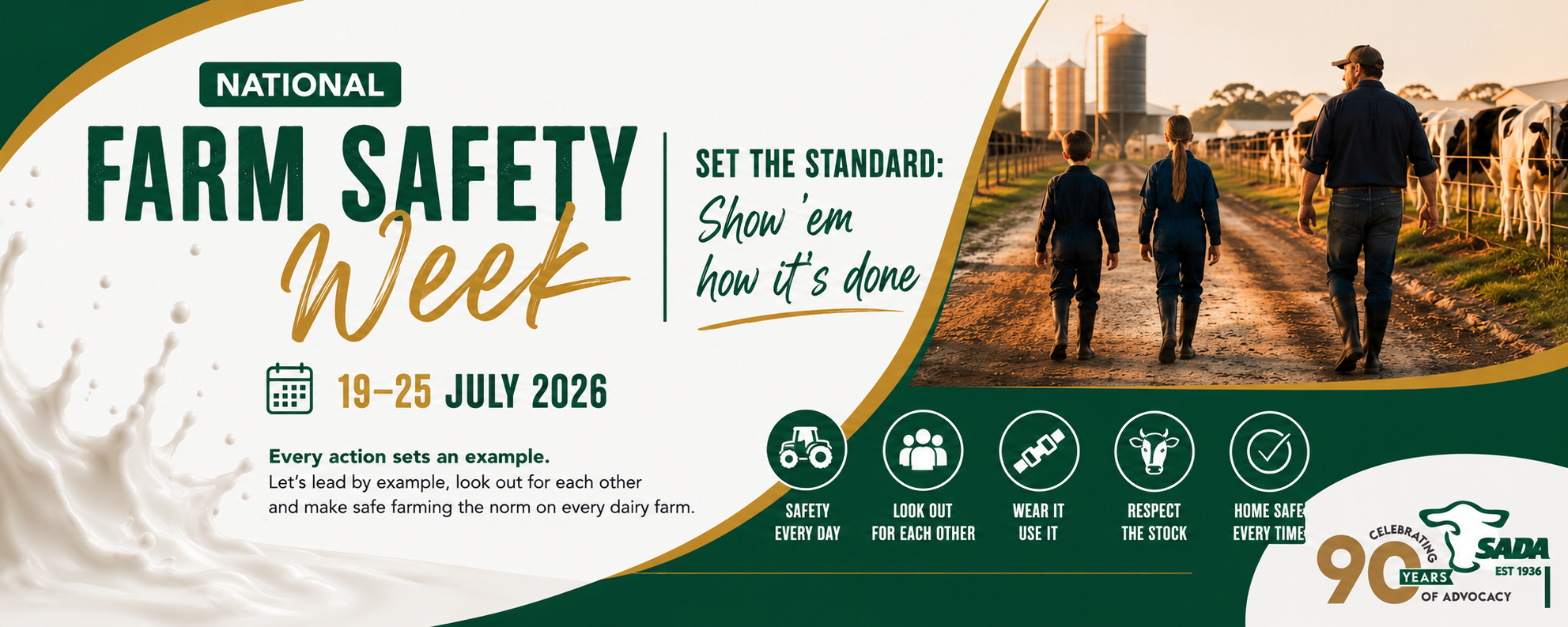
2026 National Farm Safety Week
19–25 July 2026
Set the Standard: Show 'em how it's done
The 2026 campaign focuses on the influence every farmer, manager and worker has in creating a strong safety culture. The message is that people learn by watching those around them—whether that's experienced farmers, family members, employees or contractors. By consistently demonstrating safe, practical behaviours, farmers can help make the safest choice the normal choice.
Key campaign messages include:
- Leading by example every day.
- Calling out unsafe shortcuts before they become habits.
- Creating a workplace where safe practices are simply "how we do things."
- Recognising that safety culture is built through everyday decisions rather than policies alone.
New for 2026 – Safer Farmers Ambassador Network
A major addition this year is the launch of the Safer Farmers Ambassador Network.
Six farmers from across Australia will share their own experiences through videos, media interviews and events during Farm Safety Week. Their role is to encourage conversations about:
- farm safety
- wellbeing
- leadership
- changing on-farm culture through positive role modelling.
The ambassadors have undertaken leadership and media training to help advocate for safer farming practices beyond the campaign week.
Why it matters
Agriculture remains one of Australia's most dangerous industries.
According to the Australian Government, the agriculture, fisheries and forestry sector records 9.2 workplace fatalities per 100,000 workers, making continued investment in farm safety education critical. National Farm Safety Week is supported by Australian Government funding through the National Farm Safety Education Fund.
Dairy-specific risks
Although national injury data isn't broken down by dairy enterprise, Dairy Australia identifies these as the most common high-risk activities on dairy farms:
- Working with cattle, particularly in yards, races and calving paddocks.
- Quad bikes and side-by-side vehicles.
- Tractors and telehandlers.
- Manual handling in the dairy and calf shed.
- Working around effluent ponds and confined spaces.
- Slips, trips and falls in wet dairy environments.
- Electricity and machinery maintenance.
- Fatigue during calving, harvest and busy seasonal periods.
One in every three farm injuries involves a quad bike. If you're using one every day to move stock, check water or shift fences, wearing a helmet and following safe operating procedures can make all the difference.
Australian dairy farm safety statistics
🐄 Quad bikes account for 35% of all farm injuries. According to the 2025 Farmsafe Australia Safer Farms Report, quad bike incidents remain the leading cause of on-farm injuries.
🚜 Side-by-side vehicles are now the leading cause of farm-related fatalities. As more farms replace quad bikes with side-by-sides, seatbelt use has become critical, with many fatalities occurring when occupants are not restrained.
🛵 Quad bikes cause around 15 deaths on Australian farms every year. Rollovers remain the most common cause, leading to crush injuries, head injuries and asphyxiation.
👷 Agriculture remains one of Australia's most dangerous industries. The industry records approximately 9.2 workplace fatalities per 100,000 workers, many times higher than the national average.
🚜 Farm vehicles are involved in almost 40% of all farm fatalities. Tractors, side-by-sides, quad bikes and utilities continue to be the biggest causes of fatal incidents on Australian farms.
Farm Safety Starter Kit
Developed by dairy farmers for dairy farmers, the Kit provides practical, easy to use resources to enable you to get your farm safety system started or improve the existing system.
Dairy Australia has created a suite of tools and resources to help farmers develop a comprehensive safety system on their farm and work toward the industry goal of zero fatalities on dairy farms.
Resources
Download the Farm Safety Starter kit or order your hard copy here. You can also download individual sections of the Kit, as you need them to use on your farm:
Getting Started: complete the safety checklist, follow with the induction process before moving to the 3 key parts of the Kit.
You can also download the induction checklist.
Safety System Snapshot: use the snapshot with your farm team to check your farm safety system against the current Work Health and Safety Legislation & create an Action plan.
Earlier Safety Improvements: use this tool to think back over the last 2-3 years and make a list of safety improvements you have made – some may not have been done just for safety reasons, but have improved the workplace from a safety perspective.
Quick Safety Scans (14 scans): a set of 30 minute scans on the key hazard areas, designed to assist you in identifying and fixing hazards identified. The safety scans are designed to be used when setting up your safety system and then for ongoing reviews.
Action Plan: when you identify areas for improvement, add these to the Action plan.
Note: the Farm Safety Starter Kit compliments the Employment Starter Kit initiative (ESKi) which contains more information regarding induction.

Farmers' guidebook to work health and safety
There’s no question that farms are unique workplaces, and the combination of hazards makes primary industries one of the most dangerous sectors in which to work. In South Australia 4.5% of the total workforce works in agriculture; however, almost 19% of workplace deaths occur on farms.
This means South Australian farmers are being fatally injured at a rate of almost 5 times their share of the workforce. On top of the high fatality rate, every week 9 South Australian primary producers are injured seriously enough to access work injury insurance. Frustratingly, the vast majority of fatalities and serious injuries are preventable.
Commodity groups most at risk of serious injury are sheep, beef cattle and grain production, followed by grape growing and fruit and tree nut growing. For the period 2012-2016, the most common farm injuries across the agriculture sector were caused by:
- muscular stress while manual handling or lifting
- falls on the same level
- vehicle accidents
- being hit by animals.
As an experienced farmer, you may think you have safety covered – but it’s experienced farmers who are most likely to die on-farm.
https://www.safework.sa.gov.au/industry/agriculture

Farmsafe Australia is committed to keeping you safer on Australian farms.
Our mission is to improve the wellbeing and productivity of Australian agriculture through enhanced health and safety awareness and practices.
https://farmsafe.org.au